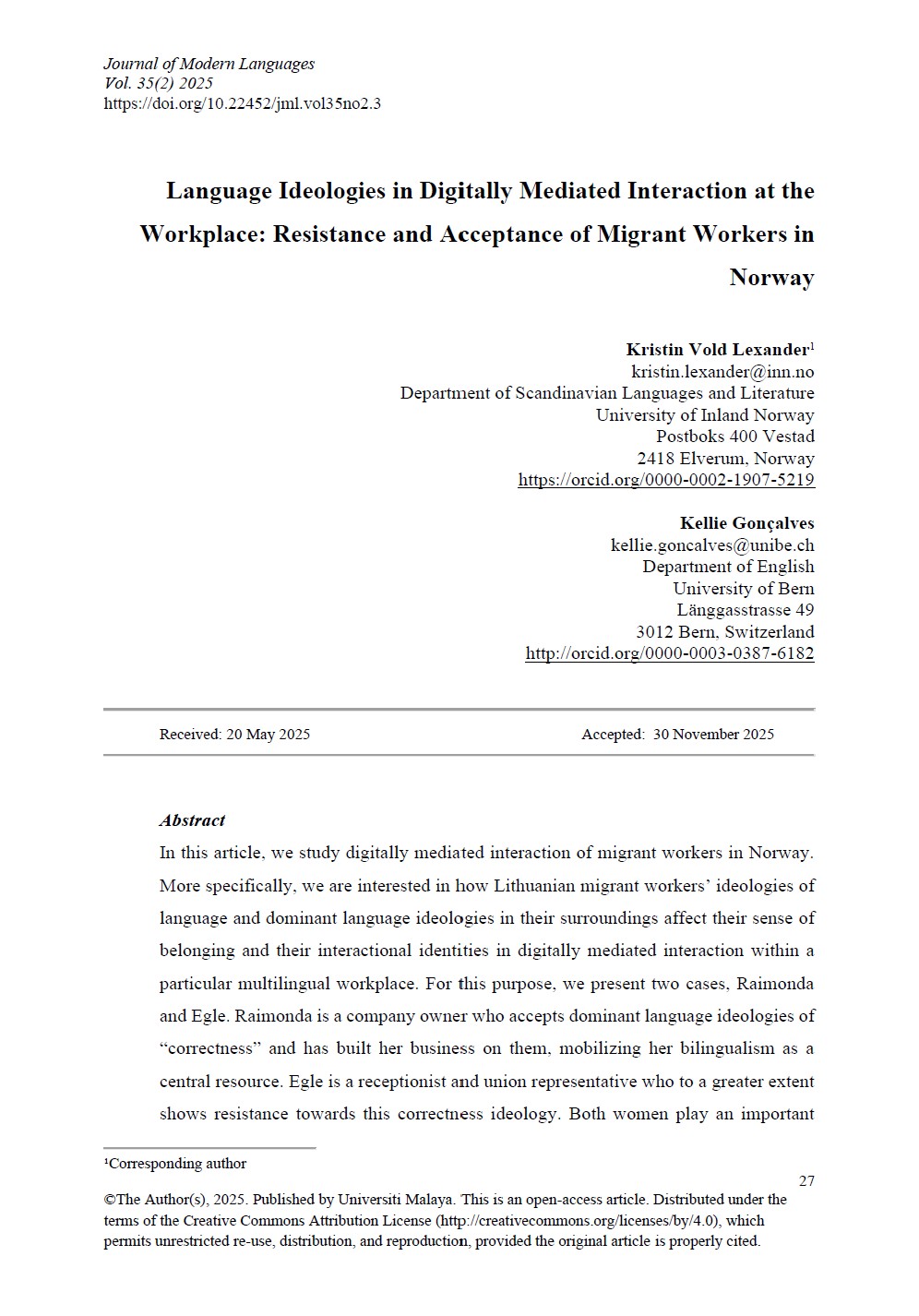
Language ideologies in digitally mediated interaction at the workplace: Resistance and acceptance of migrant workers in Norway
DOI:
https://doi.org/10.22452/jml.vol35no2.3Keywords:
Workplace, Language Ideologies, Migrant Workers, Digitally Mediated Communication, NorwayAbstract
In this article, we study digitally mediated interaction of migrant workers in Norway. More specifically, we are interested in how Lithuanian migrant workers’ ideologies of language and dominant language ideologies in their surroundings affect their sense of belonging and their interactional identities in digitally mediated interaction within a particular multilingual workplace. For this purpose, we present two cases, Raimonda and Egle. Raimonda is a company owner who accepts dominant language ideologies of “correctness” and has built her business on them, mobilizing her bilingualism as a central resource. Egle is a receptionist and union representative who to a greater extent shows resistance towards this correctness ideology. Both women play an important language brokering role in their work. Drawing on the analytical lens of positionality, we analyse interview data and excerpts of their interaction together with their mediagrams. The aim is to understand how they tackle language ideologies in their work life, on a personal and on an interactional level, and we therefore discuss their identity construction and negotiation in terms of occupational identity and shifting micro-interactional identities within both online and offline spaces.
Downloads
Published
Issue
Section
Categories
License
Copyright (c) 2025 Kristin Lexander, Kellie Goncalves

This work is licensed under a Creative Commons Attribution-NonCommercial 4.0 International License.