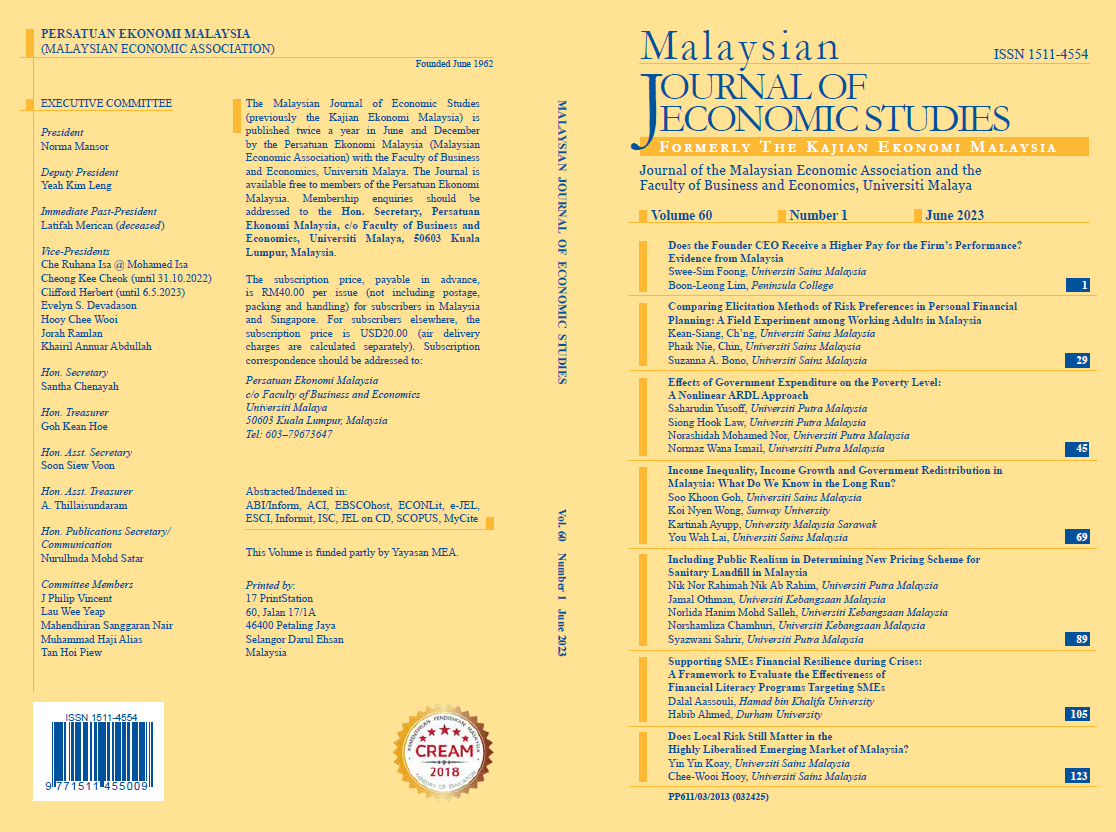
Income Inequality, Income Growth and Government Redistribution in Malaysia: What Do We Know in the Long Run?
Keywords:
Income inequality, income growth, redistribution, MalaysiaAbstract
Malaysia has a good track record of reducing income inequality, especially between ethnic groups. In recent years, increasing attention has been paid to national inequality – notably by targeting the bottom 40% income group while sustaining growth with inclusivity. This paper uses the latest cointegration technique, namely, the augmented autoregressive distributed lag (A-ARDL) to examine the long-run determinants of income inequality in Malaysia. The long-run results suggest that income inequality is negatively driven by real GDP per capita and government redistribution of income. The findings provide some possible policy implications that could reduce income inequality in the long run, in particular, through the enhancement of the quality and skills of the workforce, and the government’s benevolent role by using redistributive instruments such as progressive income tax and cash transfers to low-income groups.